
Educational Ecosystem
Impact begins before an audience ever sees the film.
Minding Shadows is not only a documentary. It is a curriculum, a community, and a growing library of healing resources — designed from the beginning to create measurable change in how people understand trauma, resilience, and reconciliation.
The film is the catalyst. The educational ecosystem is the intervention.
260+ participants in our Emerging Creators Network
-
42 countries represented
-
5 educational toolkits
-
10 years in development
-
260+ participants in our Emerging Creators Network - 42 countries represented - 5 educational toolkits - 10 years in development -
-THE HEALING FRAMEWORK-
Body. Mind. Community.
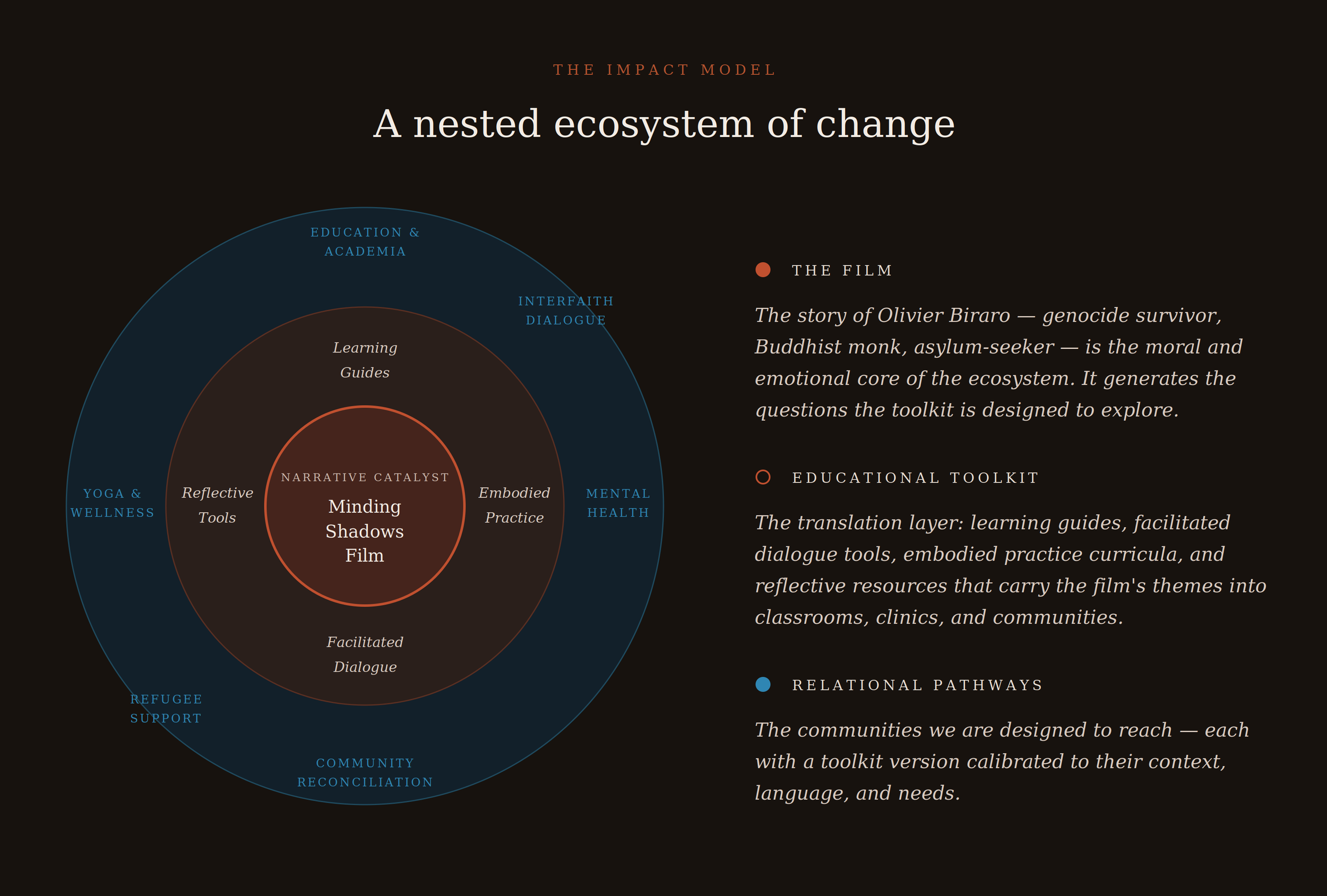
The educational toolkit is organized around three interconnected sites of healing drawn from the film's protagonist and his decades of practice in post-genocide Rwanda, Uganda, Sri Lanka, and Germany. These are not abstract themes — they are documented methods, taught in lived contexts, now translated into accessible educational form.

BODY
-Embodied Practice-
Healing through movement. Martial arts, yoga, and tai chi as disciplines that process trauma physically — quieting the nervous system and rebuilding a sense of agency in the body.
Yoga teachers & somatic practitioners
Mental health & wellness providers
Community healing programs
2. MIND
-Mindfulness & Shadow Work-
Healing through awareness. Mindfulness meditation and Jungian shadow work as frameworks for transforming grief, rage, and shame — not by suppressing them, but by facing them directly.
Mental health practitioners
Undergraduate classrooms
Trauma-informed educators
3. COMMUNITY
-Ubuntu & Reconciliation-
Healing through relationship. Ubuntu — I am because we are — as a philosophy of communal repair, used here to guide facilitated dialogue in communities navigating conflict, displacement, and difference.
Communities receiving refugees
Post-conflict reconciliation programs
Interfaith & interreligious practitioners
